
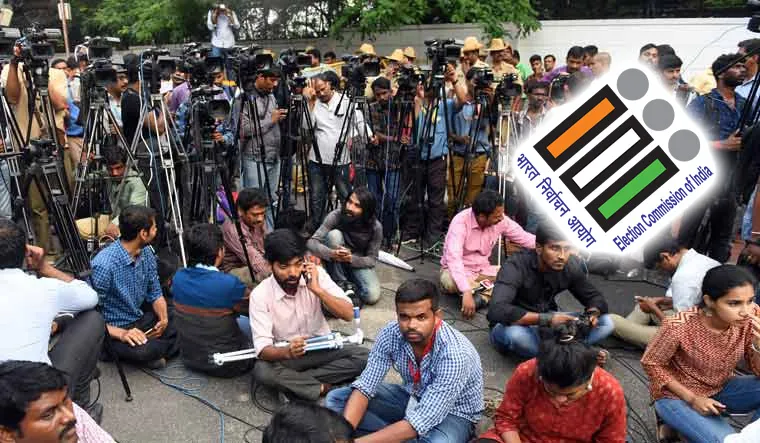
The Election Commission of India (ECI) has allowed media personnel on duty related to poll day coverage to vote through postal ballot in the upcoming Lok Sabha elections.
Giving further information, Chief Electoral Officer (CEO) Sibin C said, “According to the notification issued by the ECI, media personnel authorized by ECI for poll day coverage and other state government department officials can vote via postal ballot under Section 60 (c) of the Representation of the People Act, 1951.”
The CEO said that as per the notification, the ECI has notified journalists holding authorization letters issued by the ECI who are engaged in polling day coverage as essential service personnel, along with staff from 6 government departments.
He said that these departments include Department of Local Government (Fire Services), Department of Transport (Drivers, conductors, Work shop staff, Operations staff and Officers posted at Headquarters and Depots at District level), Department of Jails (Superintendent, Deputy Superintendent, Assistant Superintendent, and Guarding staff posted in Jails), Department of Home Affairs and Justice (Police officers, Police personnel, Civil Defense, and Home guards), Department of Power (Staff of State power corporation and state transmission corporation deputed at Generations units), Thermal plants, Hydel units (within or outside state), Staff on deputation to BBMB and field Staff posted in Grid substation, Department of Health and Family Welfare (a) Drug Control Officers working under the Commissionerate of Food and Drugs administration (b) Medical and Para-medical Staff working/on duty on the day of poll.
He said that the aim of this is to ensure that no one is deprived of voting due to their service commitments.
“Strength lies not in unrestrained behaviour but in well-regulated action”, said Pandit Deendayal Upadhyaya (1916-1968). The co-founder of the Bhartiya Jana Sangh (BJS) and a prominent thinker of RSS had famously espoused the idea of ‘Antyodaya’, or upliftment of the last man in the queue. Drawing inspiration from the same philosophy, the present-day Indian Government has taken noteworthy strides in the realm of healthcare. “Health for All” has been the guiding mantra behind the transformation the Indian healthcare sector has witnessed over the past 10 years.
The prime drivers of this initiative are health system strengthening in rural and urban areas, Reproductive-Maternal-Neonatal-Child and Adolescent Health (RMNCH+A) and Communicable and Non-Communicable Diseases. This is broadly subdivided into the National Rural Health Mission (NRHM) and the National Urban Health Mission (NUHM). The services envisaged under these missions are facilitated by a network of social health centres and other schemes, like:
- ASHA – More than 9.15 lakh Accredited Social Health Activists (ASHA) are in place to facilitate and mobilize community healthcare.
- Rogi Kalyan Samiti/Hospital Management Society – Members of this registered society act as trustees to manage and improve facilities at hospitals. 31,763 Rogi Kalyan Samitis (RKS) have been set up involving almost all District Hospitals, Sub-District Hospitals, Community Health Centers, and Primary Health Centers.
- The Village Health Sanitation and Nutrition Committee (VHSNC) – This is a major tool for community empowerment at the grassroots level. VHSNC membership includes ASHA and other frontline workers, as well as Panchayati Raj representatives. To date, around 5.01 lakh VHSNCs have been set up across the country.
- Janani Suraksha Yojana (JSY) – This flagship program aims to reduce maternal mortality among pregnant women by encouraging them to deliver in Gov health facilities. Ever since NHRM was set up, more than 8.55 Cr women have benefited from this program. One key outcome that has been witnessed is a sharp decline in Maternal Mortality Ratio (MMR), from 130/lakh in 2014 to 97/lakh in 2020.
- Janani Shishu Suraksha Karyakram (JSSK): JSSK entitles all pregnant women delivering in public health institutions to free and no-expense delivery, including the Caesarian section. Free drugs and consumables, free diet, free provisions of blood, and free to-and-fro transportation from home to health institution and back – are features of this scheme.
Robust health infrastructure development:
This can broadly be divided into 2 areas:
Expanding healthcare facilities, including hospital beds: As per Rural Health Statistics (RHS) 2020, as on 31.03.2020, public health facilities in India were –
- 1,57,921 Sub Centres (SCs)
- 30,813 Primary Health Centres (PHCs)
- 5,649 Community Health Centres (CHCs)
- 1193 Sub-divisional Hospitals (SDHs) & 810 Districts Hospitals (DH)
To improve quality in over 31,000 public facilities, a National Quality Assurance Framework for Health facilities was introduced soon after this government assumed power in 2014. A notable initiative called Kayakalp was introduced, where public healthcare facilities would be appraised and evaluated around cleanliness, hygiene, etc, and exceptional centres would be rewarded.
Newborn Care Corners (NBCCs) were established to provide essential newborn care at points of delivery, while for sick newborns, Special Newborn Care Units (SNCUs) were started across the country.
To promote the usage of generic drugs at affordable price points, Pradhan Mantri Bhartiya Janaushadhi Pariyojana (PMBJP) was introduced, which covers 1965 drugs and 293 surgical equipment to be sold at retail shops 50% to 90% cheaper than branded medicines. Since 2014, the number of Janaushadhi Kendras has shot up around 100 times, from 80 to 10,000 now.
COVID-19 was a testing ground around how swiftly India can adapt to providing facilities and vaccinations to its enormous population. From 2020 to Nov 2022, 3388 Testing laboratories were made operational at a breakneck pace. The largest vaccination drive in the world commenced on 16th January 2021, and as it turns out, this has been a stellar success story for the present-day Government. As of 6th January 2023, more than 220 crore COVID-19 vaccine doses had been administered, with 97% of eligible beneficiaries already receiving at least one dose, and around 90% receiving both doses. This involved training more than 2.6 lakh vaccinators, and 4.8 lakh other vaccination team members, outreach to the masses and logistics around storing and transporting vaccines involving 29,000 cold chain points. The digital platform Co-WIN was a big enabler to the vaccination program. Under the Vaccine Maitri program, vaccines and other medical assistance were provided to over 150 nations.
- Expansion of medical education: To cater to the increasing demand for quality healthcare, GoI over the last 9 years has expanded the number of medical colleges and MBBS seats at a staggering pace. From a mere 387 medical colleges in 2014 to 689 in 2023, the number has increased by around 78%. The number of AIIMS has also shot up from 7 to 22 over the same time-period.
Not just medical colleges, number of MBBS seats has gone up by 105%, from 51,300 in 2014 to 1,05,383 in 2023. The Number of PG seats over the same time-period has zoomed 110%, from 31,185 to 65,335.
An interesting observation here is, the growth rates (GR) as above for India far outshine those of the USA and Canada, as depicted in the diagram below: