
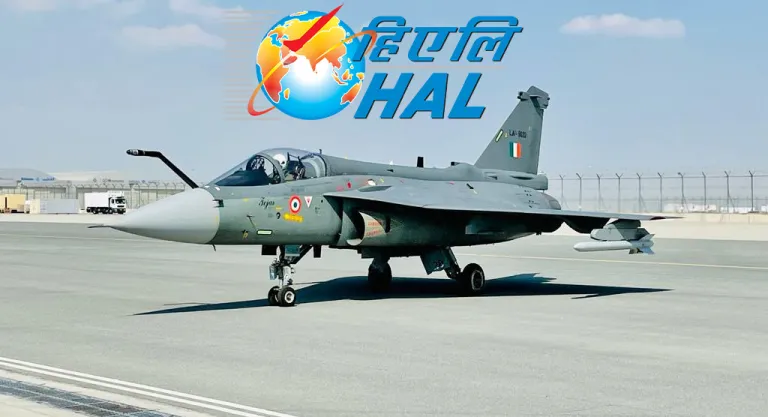
The Defence Ministry has issued a tender to the public sector firm Hindustan Aeronautics Limited for purchasing made-in-India 97 LCA Mark 1A fighter jets expected to be worth over Rs 65,000 crore.
This is set to be the largest order for indigenous military hardware to be placed by the Indian government ever.
The tender was issued by the Defence Ministry to the HAL recently and they have been given three months to respond to it.
The programme will help the IAF to replace its fleet of MiG-21s, MiG-23s and MiG-27s which have been either phased out or are set to be phased out in near future, government officials told ANI.
The indigenous fighter aircraft programme, fully backed by Defence Ministry and Air Headquarters is set to be a big boost for promoting indigenisation as well as give major business to the small and medium enterprises engaged in defence business across the country, they said.
Prime Minister Narendra Modi has been pushing for the revival of the HAL which has bagged orders for building all types of indigenous fighter aircraft, helicopters along with the engines for them under his government.
The Prime Minister also undertook a sortie in the trainer variant of the indigenous fighter which was first ever sortie by the Prime Minister of India in any combat aircraft.
The plan to acquire 97 more LCA Mark 1A fighter jets was also announced first by the Air Force chief Air Chief Marshal VR Chaudhari on foreign soil in Spain when he told ANI about the mega plans to boost the indigenous fighter aircraft orders.
The decision to buy 97 more of these planes came around after the Air Chief held a review meeting of the indigenous fighter jet programme with all entities involved including the Hindustan Aeronautics Limited.
The last order for LCA Mark1A was for 83 aircraft and the first plane is poised to be delivered in a few weeks from now. LCA Mark 1A is the advanced version of Tejas aircraft.
The LCA Mark 1A plane has more advanced avionics and radars than the initial 40 LCAs being supplied to the Air Force.
The indigenous content in the new LCA Mark1As is going to be more than 65 per cent.
The programme has been the harbinger of Atmanirbhar Bharat and Make in India initiatives of the nation. More importantly, it is a flag bearer of India’s self-reliance in the aerospace sector.
The HAL is also set to bag deals for buying over 200 LCA Mark 2s and similar number of fifth generation Advanced Medium Combat Aircraft.
It is a strategic paradox that has to be handled differently to work. Most nations have found a way out by thinking out of the box. Let me say this categorically that in this case ‘one size fits all’ does not work and cannot work.
Compulsory military service is a way forward which several nations have adopted. They all have tweaked it to fit their body size- like you buy a readymade suit but a bit of tailoring is required. Or you get a tailormade suit stitched- which can be expensive.
For instance, Singapore a tiny nation has made military service mandatory for all citizens where people between 16.5 years to 40 have to serve for two years. After this, they are let go. At the bottom most level, new recruits gets around 755 Singapore dollars per month which is INR 46,800 per month approximately.
After that you go back to where you came from. You go back to your job or if not employed back to looking for a job or studying. Their standing army is around 70,000 people and they take around 50,000 people every year for compulsory service. The guys going out are on the reservist list for the next ten years and also undergo a physical fitness test every year! Russia, France, Kuwait, Taiwan, Thailand and some more have a similar system- of course with different conditions of service. There is no state obligation to give you a job after this- you give yourself to the state and not the other way round. If the government has to absorb you then you become a part of regular standing army- these are totally two different things.
It is a force multiplier in the literal sense!
Israel mobilized some 360,000 reservists, roughly 4% of country’s population—functionally tripling the size of its force, within days, these forces were at the border fighting the Gaza war.
Need of Indian armed forces are unique- a hybrid model is adopted
Agniveer scheme has been formulated to keep the forces young and also build some kind of a reserve which can be called upon when required. Of course this would be economical too. You are taking a raw guy and training him for several months- investing your resources and also paying him money for this. An entry level person can be a school pass out (10+2) and trained for around 6 months and serves three and a half years thereafter.
In the first year, Agniveers receive a monthly package of INR 30,000, with an in-hand salary of INR 21,000. They contribute INR 9,000 to the Agniveer Corpus Fund, which is matched by the Government. As the years progress, the salary increases, with the fourth-year package amounting to INR 40,000 per month. Twenty five percent are retained and rest go back to their respective homes- now fully confident to take on the world- yes, they can then do a graduation course of their liking thereafter. He also gets a tax-free lump sum of INR 12 lakhs.
Look at the other scenario.
Let us say if a person finishes his four year graduation after school, what does he do after that? He fends for a job and mostly struggles for next three to four years, making ends meet. An average graduate gets no more than ten to fifteen thousand INR/- per month. After 8 years (4 years graduation + 4 years experience) he is not at all at an employability curve/quotient equivalent to an Agniveer with 4 years sterling experience and a 4 year degree which he does after his Agniveer stint. He is a trained, disciplined, hardened horse- with 12 lacks as bonus giving a head start of 4 years @ INR 25,000/- per month.
All of them get a work experience of 42 months. Today work experience of any type turns a greenhorn into an effective human resource. As compared to a plain graduate spending 4 years whiling away time on their parent’s money remains unemployable thereafter. Here he gets exposure to leadership, teamwork and a feeling of belonging to an elite organisation.
I have interviewed more than 8000 graduates and groomed 2000 MBA managers and I have seen that a two-month summer internship transforms their personality. 42 months is a huge experience.
This is in national interest and not an employability scheme.
If our think tanks had their way- and the large number of well-educated Indians included, they would want a compulsory military service for everyone. But this is wishful thinking.
Putting millions through this training would be cost-prohibitive. Therefore, a hybrid model would work for us and let us not find unnecessary faults in this.