
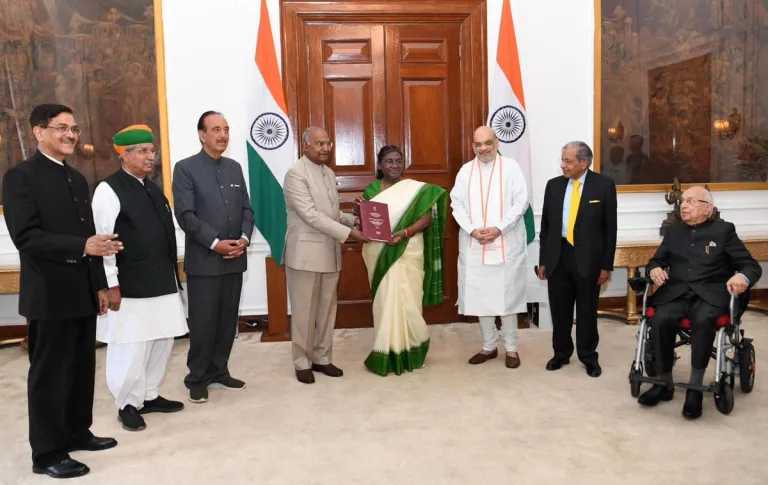
The High-Level Committee on ‘One Nation One Election’ chaired by former President Ram Nath Kovind met President Droupadi Murmu at Rashtrapati Bhavan and submitted its report on Thursday.
The Report comprises of 18,626 pages and is an outcome of extensive consultations with stakeholders, experts and research work over 191 days, since its constitution on September 2, 2023.
The committee submitted the report in the presence of all committee members including Union Home Minister Amit Shah, Union Law Minister Arjun Ram Meghwal, Democratic Progressive Azad Party (DPAP) chief Gulam Nabi Azad and others.
Recently the High Level Committee also met and interacted with representatives of several Political parties including BJP, Trinamool Congress, Samajwadi Party, CPI, CPI(M), AIMIM, RPI, Apna Dal etc.
Representatives of these parties also handed over their suggestions in writing to the committee.
The High-Level Committee relating to the holding of simultaneous elections in the country has initiated a consultation process under the chairmanship of Ram Nath Kovind, former President of India.
The High-Level Committee recently also sought public opinion regarding the one nation, one election issue. The public notice issued stated, “Notice for inviting suggestions from members of the general public for making appropriate changes in the existing legal administrative framework to enable simultaneous elections in the country.”
The central government in September last year constituted a high-level Committee to examine the issue of ‘One Nation, One Election’ and make recommendations for holding simultaneous elections in the country.
The central idea behind ‘One Nation One Election’ is to synchronize the timing of Lok Sabha and State Assembly elections across all States to reduce the frequency of polls throughout the country.
This concept was the practice till 1967, but it was disrupted due to various reasons such as defections, dismissals, and dissolutions of government.
Other members of the Committee are Amit Shah, Union Minister of Home Affairs and Minister of Cooperation, Ghulam Nabi Azad, former Leader of Opposition in Rajya Sabha, NK Singh, former Chairman, of the 15th Finance Commission, Subhash C Kashyap, former Secretary General, Lok Sabha, Harish Salve, Senior Advocate, and Sanjay Kothari, former Chief Vigilance Commissioner. Arjun Ram Meghwal, Minister of State (Independent Charge) Ministry of Law and Justice was a Special Invitee and Dr Niten Chandra was the Secretary of the high level panel.
The Committee held extensive consultations to understand the views of different stakeholders. Forty-seven political parties submitted their views and suggestions, out of which 32 supported simultaneous elections. Many political parties had extensive discussions with the High level committee on this matter.
In response to a public notice published in newspapers in all the States and Union territories, 21,558 responses were received from citizens from all over India. 80 per cent of the respondents supported simultaneous elections.
Experts on law such as four former Chief Justices of India and 12 former Chief Justices of major High Courts, four former Chief Election Commissioners of India, eight State Election Commissioners, and the Chairman of the Law Commission of India were invited by the Committee for interaction in person. The views of the Election Commission of India were also sought.
Apex business organizations like the CII, FICCI, ASSOCHAM and eminent economists were also consulted to present their views on the economic repercussions of asynchronous elections.
They advocated the economic imperative of simultaneous elections on account of the effect of asynchronous elections on fuelling inflation and slowing down the economy.
The Committee was briefed by these bodies that intermittent elections had adverse consequences on economic growth, quality of public expenditure, and educational and other outcomes, besides upsetting social harmony.
The central government in September last year constituted a high-level Committee to examine the issue of ‘One Nation, One Election’ and make recommendations for holding simultaneous elections in the country.