
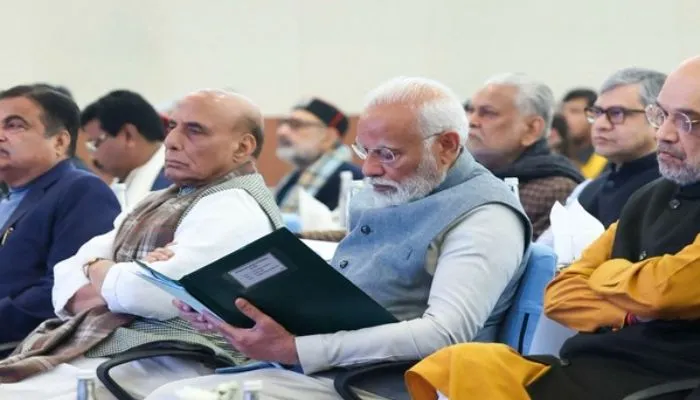
On Sunday (3rd March), Prime Minister Narendra Modi along with the Council of Ministers held an 8-hour-long meeting to brainstorm on the vision document ‘Viksit Bharat 2047’. The Council of Ministers also reportedly held deliberations on a detailed action plan for the next five years, news agency ANI reported citing sources. Notably, Council of Ministers include all Ministers including Cabinet Ministers, Ministers of state in concerned Ministries and Ministers of State Independent Charge.

During the meeting, the Council of Ministers also worked on a 100-day agenda for quick implementation after the formation of the new government in May 2024 after the general elections.
Notably, the roadmap for Viksit Bharat is a result of more than 2 years of intensive preparation. According to sources, it involved a whole-government approach involving all ministries and wide-ranging consultations with State governments, academia, industry bodies, civil society, and scientific organisations, and the mobilisation of youth to seek their ideas, suggestions, and inputs. More than 2700 meetings, workshops, and seminars were held at various levels.
The sources further added that suggestions were received from more than 20 lakh youths. According to them, the roadmap for ‘Viksit Bharat’ has a comprehensive blueprint with a clearly articulated national vision, aspirations, goals, and action points.
They added that its goals include areas like economic growth, SDGs, ease of living, ease of doing business, infrastructure, social welfare, etc.
The meeting holds significance, as the BJP-led ruling National Democratic Alliance (NDA) has expressed confidence in retaining power at the Centre for a third term. On several occasions, PM Modi has exuberated confidence reiterating that it is his guarantee, ‘Modi ki guarantee’, that India will become the 3rd largest economy in the world in his third term. He, however, added that he is not seeking a third term for himself but to do service for the nation.
In his rallies, PM Modi had stated that ‘Abki baar 400 par for NDA and over 370 seats for BJP’ is a slogan coined by the public. On 2nd March, the party’s central election committee announced candidates for 195 seats for the upcoming Lok Sabha elections.
Meanwhile, the Election Commission is likely to announce the poll schedule in a couple of weeks as elections are held in April-May with the newly elected government assuming power in late May or June.
A tripartite agreement was signed in the presence of Union Home Minister Amit Shah, between Government of India, Government of Tripura and The Indigenous Progressive Regional Alliance/TIPRA, popularly known as Tipra Motha and other stakeholders, in the national capital on Saturday.
On this occasion, Amit Shah said, “Today is a historic day for Tripura, and through this agreement, we have looked at the future by honouring history, making amends, and accepting today’s realities.”
“No one can change history, but we can always move forward by learning from mistakes and keeping in mind today’s realities. He said that Tipra Motha and all tribal parties have played a constructive role in this direction,” he added.
Union Home Minister said that the Tripura government has always made several efforts for this. He said that in realising Prime Minister Narendra Modi’s dream of a Viksit Bharat, Tripura will also be committed to making its contribution and having its share and will move forward as a Viksit Tripura.
Further, the Home Minister talked about efforts made under the leadership of PM Modi insurgency-free, dispute-free, and violence-free Northeast.
“Under the leadership of Prime Minister Modi, Ministry of Home Affairs has made efforts to give shape to vision of an insurgency-free, dispute-free and violence-free Northeast. He noted that due to several agreements by Modi Government, around 10 thousand people have given up arms and joined mainstream, which has resulted in creation of an environment of development.”
“Be it Bru-Reang agreement or border agreement, it all started with Tripura and today again it is an agreement for Tripura. He said that in 2019 NLFT (SD) agreement, in 2020 Bru and Bodo agreements, in 2021 Karbi-Anglong agreement, in 2022 Tribal agreement and Assam-Meghalaya border agreement, in 2023 Assam-Arunachal Pradesh border agreement, Dimasa agreement UNLF and then ULFA agreement have taken place,” He added.
He said that Modi government has worked to end struggle of people by talking to them through 11 different agreements related to borders, identity, language and culture.
Shah said that with today’s agreement, Tripura has moved forward to become a dispute-free Tripura. He said that now you do not have to struggle for your rights and the Government of India will come forward to develop a system which will protect rights of all.
Under the pact, it was agreed to amicably resolve all issues of indigenous people of Tripura relating to history, land and political rights, economic development, identity, culture and language. Along with this, it was agreed to constitute a Joint Working Group/Committee to work out and implement the mutually agreed points on all the above-mentioned issues in a time-bound manner to ensure an honourable solution.
In order to maintain a conducive atmosphere for the implementation of the pact, all stakeholders shall refrain from resorting to any form of protest/agitation, starting from the day of signing of the agreement.
On behalf of TIPRA, the agreement was signed by Pradyot Debbarma, Founder TIPRA and others. Prof. (Dr.) Manik Saha, Chief Minister, Tripura and several senior officials of Ministry of Home Affairs, GoI and the Government of Tripura were also present during the signing of the agreement.